
Crowd Management Techniques That Help Teams Plan, Staff, and Control High-Pressure Events
SEO Title: Crowd Management Techniques: Practical Plans, Safe Staffing, and Rapid Response Strategies for Event Teams
SEO Description: Learn essential Crowd Management Techniques, from risk assessments and flow control to temporary event staff training. Hire Staff Today with proven planning methods.
Crowd Management Techniques are the operational disciplines, planning tools, and on-site behaviours that help event teams keep large groups safe, comfortable, and moving efficiently. Whether you are running a concert, football match, conference, city festival, retail opening, or temporary exhibition, the same core challenge applies: people need to be guided without panic, bottlenecks need to be prevented, and staff must be prepared for sudden changes in pressure. The best Crowd Management Techniques are not simply about barriers or stewards; they are about intelligent design, clear communication, trained teams, and continuous risk review.
This guide explains the most important Crowd Management Techniques, how to apply them in real venues, and why staffing quality is often the difference between a smooth event and a dangerous incident. You will learn how to build a safer flow plan, train temporary crews, use practical on-site controls, and create a professional response culture that protects both attendees and your reputation.
Interactive Overview of Crowd Management Techniques
Planning and Risk Assessment
Strong Crowd Management Techniques begin before gates open. The planning stage should identify likely crowd profiles, arrival patterns, venue limits, weather risks, emergency routes, and vulnerable groups. A written risk assessment should cover ingress, egress, congestion points, ticket fraud, alcohol, medical incidents, protest activity, and any nearby transport disruption. The goal is to anticipate pressure rather than react to it.
- Map entry, exit, and internal movement routes.
- Set safe capacity limits for each zone.
- Review accessibility, welfare, and emergency needs.
- Assign clear roles to supervisors and stewards.
On-Site Flow Control
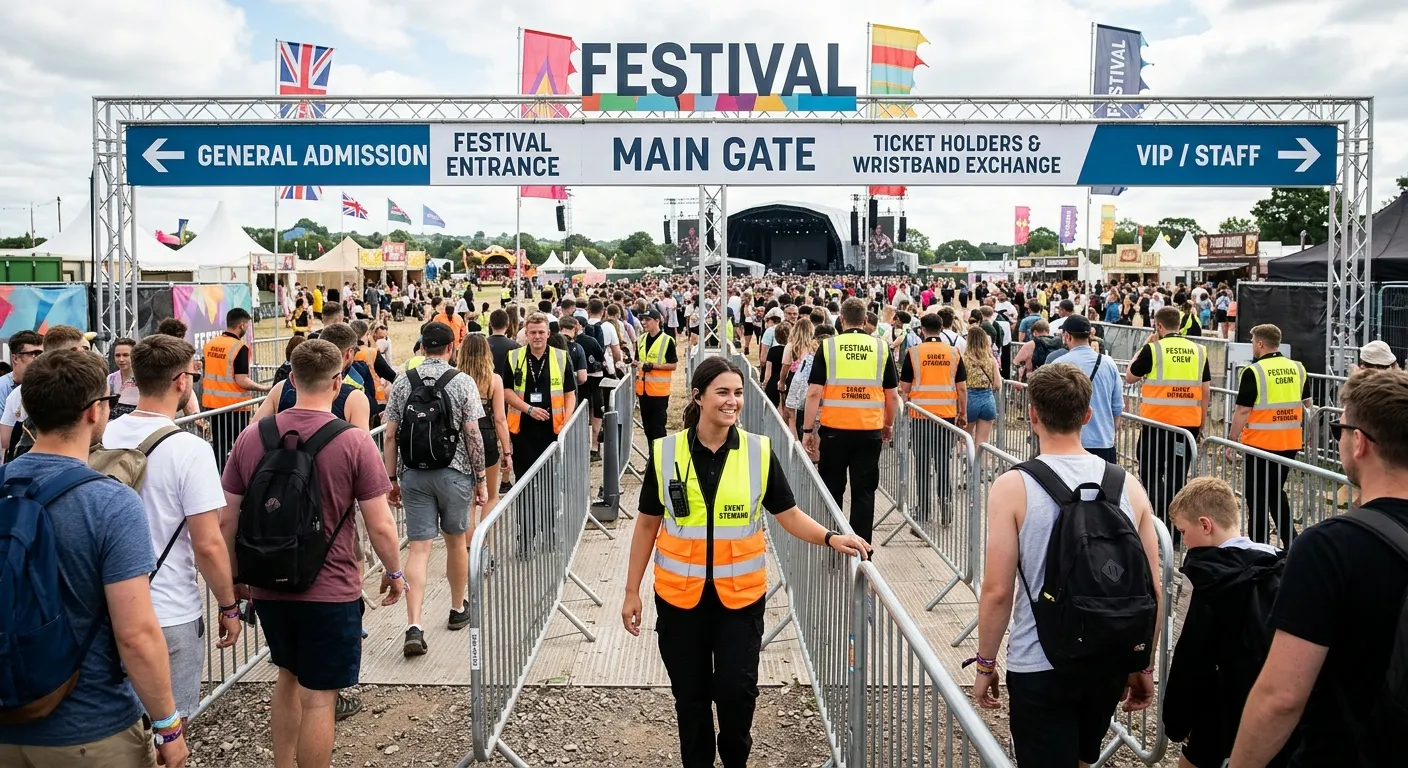
Flow control is one of the most visible Crowd Management Techniques. It uses layout, barriers, signage, and staff positioning to keep movement predictable. Wide channels, clear lanes, controlled pinch points, and well-lit exits reduce confusion. When crowds can see where to go, they are less likely to push, cluster, or create dangerous surges.
- Use one-way systems where appropriate.
- Separate ticket types with clear lanes.
- Prevent dead zones and sudden bottlenecks.
- Protect emergency access at all times.
Staffing and Communication
Staffing is the human engine behind effective Crowd Management Techniques. Stewards, supervisors, marshals, security, medical teams, and temporary event crew must understand their brief, know escalation routes, and communicate calmly. Good staffing prevents many incidents because trained people can spot early warning signs such as crowd compression, uneven density, or unsafe behaviour.
- Brief every team member on location and duty.
- Use consistent radio or mobile protocols.
- Provide visible uniforms and identification.
- Train staff in de-escalation and customer care.
Monitoring and Response
Modern Crowd Management Techniques rely on continuous monitoring. CCTV, density sensors, gate counters, social media, and on-ground supervisors help teams see pressure building. Response plans should be simple: slow entry, open relief zones, redirect movement, pause ticket sales, or deploy additional staff. The key is early intervention before a small issue becomes an emergency.
- Track queue times and density trends.
- Review incidents in real time.
- Update signage and announcements quickly.
- Record lessons for future events.
Core Benefits of Well-Executed Crowd Management Techniques
Safety First
Keeps people protected by reducing compression, confusion, and unsafe movement. Trained staff and clear routes create a calmer environment.
Smoother Flow
Improves entry speed, reduces queues, and prevents bottlenecks through smart layout and lane discipline.
Better Visitor Experience
Attendees who know where to go are less stressed and more likely to enjoy the event.
Stronger Compliance
Helps venues meet licensing, safety, and operational requirements with documented risk assessments and staff briefings.
Faster Incident Response
Clear escalation routes and monitoring allow teams to address problems before they spread.
Improved Reputation
Safe, well-run events build trust with attendees, partners, regulators, and local communities.
What Are Crowd Management Techniques?
Crowd Management Techniques are proactive methods used to guide, monitor, and protect large groups of people in public spaces. They are often confused with crowd control, but the two are not the same. Crowd control usually reacts to disorder, while crowd management prevents disorder by designing safer systems, training staff, and reducing risk before people arrive.
In practice, Crowd Management Techniques combine venue design, operational planning, staff deployment, communication, technology, and welfare measures. They apply to festivals, stadiums, transport hubs, city centres, conferences, pop-up stores, and temporary events. The objective is not just to move people quickly, but to move them safely, predictably, and with dignity.
Core Principles Behind Effective Crowd Management Techniques
The most reliable Crowd Management Techniques follow a few non-negotiable principles. First, safety takes priority over speed. If a queue moves faster but becomes dangerous, the system has failed. Second, simplicity works best. Attendees respond better to clear instructions than complex signage. Third, supervision must be visible. Staff should be present, calm, and identifiable. Fourth, planning must be evidence-based, using previous incident data, venue measurements, and realistic arrival assumptions.
- Design for predictable movement.
- Control density before it becomes unsafe.
- Communicate consistently across all channels.
- Train staff for normal operations and emergencies.
- Review and improve after every event.
These principles make Crowd Management Techniques practical rather than theoretical. They also help teams decide where to invest: better barriers may help, but better briefing, staffing, and flow design often deliver a greater safety improvement at lower cost.
Practical Crowd Management Techniques You Can Apply Today
Start with ingress and egress planning. Entry and exit are where many incidents begin because people arrive together and leave quickly. Use staggered arrival times, separate ticket categories, and controlled release points. If possible, design entry routes that prevent opposing flows from crossing. For egress, open multiple exits, keep routes clear, and ensure lighting and signage are strong enough for tired attendees.
Zone-Based Crowd Management Techniques
Divide the venue into zones with clear responsibilities. A zone-based approach allows supervisors to manage density locally instead of trying to control the entire crowd from one point. Each zone should have a named lead, a communication channel, a capacity threshold, and an action plan if pressure rises. This is especially useful for festivals, arenas, and large outdoor events.
Dynamic Staffing and Patrols
Static positions are not enough. Effective Crowd Management Techniques include roaming stewards, mobile supervisors, and early-response teams. Patrols can spot queue compression, unsafe climbing, medical distress, or aggressive behaviour before fixed posts notice them. Staff movement should be planned, not random, with priority given to bottlenecks, barriers, and high-density areas.
Communication and Signage
Signage must be visible, consistent, and multilingual where required. Use colour coding, arrows, and large fonts. Public announcements should be calm, short, and repeated. Stewards should carry simple scripts for common questions. Clear communication reduces uncertainty, and uncertainty is a major trigger for crowd stress.
Pro Tip: Use a pre-event walk-through with supervisors, stewards, and emergency services to test routes before gates open.
Why Staffing Quality Makes Crowd Management Techniques Work
Many teams invest heavily in barriers, CCTV, and software, then underinvest in people. That is a mistake. Crowd Management Techniques depend on trained, reliable staff who can read a crowd, follow procedures, and communicate professionally. Temporary event crews can be excellent when they are briefed properly, supervised well, and matched to the right role.
If you need short-notice cover, consider using a specialist Events & Promotions partner or a flexible Temp Workforce solution. The same principle applies in many regions: teams need dependable crew members who can set up, marshal, clean, and respond quickly. For example, operators searching for Same-Day Event Set-Up Crew Member Positions In Wrexham often need staff who can move fast while still following safety instructions.
Hiring alone is not enough. Use structured induction, role cards, buddy systems, and supervision checks. A temporary steward who understands the venue layout, radio protocol, and escalation process is far more valuable than an untrained worker placed in a high-pressure zone. If you are building a longer-term staffing strategy, read our guide to Optimize Hiring for 2026 to align workforce planning with operational risk.
Video Insight: Scaling Event Staff Quickly
When crowd demand changes, staffing must change too. This video explains how employers can hire 10, 20 or 50 temporary workers at short notice.
Pro Tip: If a queue exceeds safe density, pause entry and relieve pressure rather than forcing movement.
Pro Tip: Keep temporary staff out of high-risk posts unless they have completed site-specific training.
A Simple Roadmap for Implementing Crowd Management Techniques
Assess
Review venue, capacity, arrival patterns, risks, and previous incidents.
Design
Create flow layouts, zones, signage, staffing levels, and emergency routes.
Brief
Train all staff, including temporary workers, on roles, escalation, and customer care.
Monitor
Use on-ground observation and data to manage density and response.
Review
Record incidents, queue times, and feedback to improve the next event.
Common Mistakes That Undermine Crowd Management Techniques
One common mistake is treating staffing as an afterthought. Event leaders often assume stewards will learn as they go, but untrained staff can create confusion and risk. Another mistake is over-relying on barriers. Barriers help, but they cannot replace clear routes, signage, and supervision. If people do not know where to go, barriers can create pressure points.
- Failing to test emergency evacuation routes.
- Ignoring accessibility and vulnerable attendees.
- Using too many signs instead of clear instructions.
- Deploying staff without communication checks.
- Waiting for an incident before changing the plan.
A third mistake is poor data use. Some teams collect gate numbers but never analyse density, queue time, or incident trends. Effective Crowd Management Techniques require simple but consistent measurement. Even a basic log of entry times, supervisor observations, and radio calls can reveal patterns that prevent future incidents.
Technology That Strengthens Crowd Management Techniques
Technology can improve Crowd Management Techniques when it supports human judgment, not replaces it. CCTV, thermal imaging, Wi-Fi sensing, gate counters, and mobile incident apps help teams understand movement. The key is to use technology to answer operational questions: Where is pressure building? Which exit is underused? How long are queues? Are staff responding quickly?
Practical Technology Tools
- Gate counters for real-time attendance.
- CCTV for density and incident review.
- Radio apps for fast escalation.
- Digital signage for dynamic route changes.
Do not assume expensive systems are necessary. A well-trained supervisor with a radio, a clipboard, and clear instructions can often manage risk better than an unused sensor. The best technology is simple, reliable, and integrated into daily briefings.
Applying Crowd Management Techniques to Different Venue Types
Stadiums, festivals, transport hubs, and city events each require tailored Crowd Management Techniques. In stadiums, ticketing zones, concourse pressure, and post-match egress are critical. In festivals, camping areas, stage entrances, and alcohol service create additional risks. In transport hubs, peak-time density and passenger confusion demand clear wayfinding and rapid staff deployment.
Retail and conference environments may seem calmer, but they can still create congestion at entrances, registration desks, and session rooms. The same principles apply: control density, separate flows, brief staff, and monitor pressure points. For smaller venues, the plan may be shorter, but it must still be specific, realistic, and tested.
Building a Flexible Event Workforce for Crowd Management
Crowd demand is rarely static. Weather, artist changes, ticket releases, transport disruption, and social media can all shift pressure within minutes. A flexible workforce helps teams adapt without losing control. This is why many organisations use temporary staff, agency crews, and cross-trained internal teams to scale quickly.
When hiring fast, clarity is essential. Provide job cards that state location, role, shift length, reporting line, and escalation contact. Ensure temporary workers can access welfare facilities, receive breaks, and understand site rules. A supported temporary workforce is safer, more professional, and less likely to make operational errors.
If your event needs urgent cover, Hire Staff Today through a trusted staffing partner and build a team that can support your Crowd Management Techniques from the first briefing onward.
Remember: the strongest Crowd Management Techniques fail without consistent supervision, clear communication, and staff who understand the venue.
Frequently Asked Questions About Crowd Management Techniques
Crowd Management Techniques are proactive planning and operational methods used to guide large groups safely. They include risk assessments, flow design, signage, staffing, monitoring, and emergency procedures. The aim is to prevent unsafe conditions before they develop.
Crowd control reacts to disorder, often using containment, barriers, or force. Crowd management prevents disorder by designing safer environments, training staff, and reducing risk before incidents occur. Management is broader and more strategic than control.
Yes. Small events can still create bottlenecks, unsafe stairways, poor lighting, or emergency access issues. The scale may be smaller, but the principles of capacity, flow, supervision, and communication still apply.
There is no universal ratio. Staffing depends on venue layout, density, ticketing, weather, alcohol service, emergency routes, and attendee vulnerability. A proper risk assessment should determine staffing levels and supervision requirements.
Yes, if they are properly briefed, trained, supervised, and assigned to suitable roles. Temporary staff can be very effective when job cards, site induction, welfare arrangements, and escalation routes are clear.
Assuming that barriers, uniforms, and a few staff members are enough. Without clear flow design, communication, monitoring, and trained supervision, even well-resourced events can create dangerous congestion and confusion.
Employers should review incidents, test routes, invest in staff training, use simple data, and plan for surge scenarios before they happen. Continuous improvement and disciplined briefing are essential.
Ready to Build Safer Events with the Right Staffing?
Effective Crowd Management Techniques need more than a plan. They need reliable people on the ground, clear communication, and trained temporary crews who can respond quickly. If you need event stewards, crew, supervisors, or short-notice temporary workers, start your hiring request today.